Good morning brothers and sisters, and Happy Old New Years! Today for former Soviet countries it is Old New Years! They used to use the Julian calendar so their holidays were 2 weeks after ours. This month is often known as Drunkuary because they remain drunk for New Years, Christmas (for them on Jan 7th), and Old New Years. As missionaries we had very few ‘productive’ missionary lessons in January.
As I think of my mission in Ukraine, in this month of Drunkuary, I’m reminded of one of the most spiritually powerful moments on my mission. It was when I was able to help Jesus directly and personally. Jesus had fallen over, had vomit on his coat, and was incapable of getting up; he was so old and so drunk that he couldn’t stand and walk upstairs to his place. Christ cried out to my companion and I with slurred speech for help. As we helped him up the stairs, into his apartment, and onto his bed he shed repeated tears of gratitude. If we hadn’t walked by, Jesus would likely have frozen to death in the cold as many Russian men do. I hadn’t realized it was Jesus until, during his 15th tearful and slurred ‘thank you,’ the verse came to mind “Inasmuch as ye have done it unto one of the least of these my brethren, ye have done it unto me.”
I must also note that more often than instances like that story, I have left Jesus hungry, begging for change as I question his motives. I don’t believe anyone falls purely into the “good” camp or the “bad,” but we’re all striving to do and be more good (which, incidentally, is what Joseph once said was the translation of Mormon. Mormon = ‘more good’).
Brothers and sisters, I was asked to give some historic context to the 2 great commandments, but as I do so, I’d like us all to keep in mind the power and importance of Love as the previous talks have so beautifully discussed.
First, some rhetorical questions:
Why does it matter which commandment is greater? Why are we asking these questions? Why did the people in the scriptures ask these questions of Jesus?
Let’s start by noting that these questions were all posed by Jews. They were “God’s chosen people.” So the question for them (and for us) is how do we please God? How do we live up to the covenant/chosen status? How do we become holy? At the time of Jesus there were two major schools of thought, roughly speaking, those of the Sadducees and the Pharisees.
The Sadducees believed we become holy and please God through the temple and the Priests/Levites. They believed that the people support them with donations and the Priests and Levites perform ordinances vicariously to keep the nation collectively holy.
Now the Pharisees felt differently. They have a bad reputation in the church. Their motives and movement was actually one that I think most Christians can admire. They felt that the ability to come close to God and be holy was not a monopoly held by Levites and Priests, but that ALL can be holy and have God intimately involved in their lives. They thought someone can be holy by following the scriptures and prophetic commentary on the scriptures with exactness. Thus everyone can attain a level of holiness and please God, even in their mundane daily activities. For them religion, purity, and scriptures were for everyman, not only the priests.
So these are the main schools of thought in the time of Jesus. So let’s see what Jesus thought by jumping into the examples from the New Testament about the 2 great commandments. When we look at them, what do we learn from each of these accounts AFTER Christ lists to two great commandments? (We’ll go through them in the chronological order in which the gospels were written) so we start with Mark.
In Mark we read the story of the 2 great commandments in the final week of his life, after Jesus’ entry into Jerusalem and after he had cleansed the temple. The Pharisees had already approached Jesus trying to trick him with the question about taxation, and Jesus had answered unscathed. After this, the Sadducees saw their opportunity to trap Jesus (because obviously the Pharisees wouldn’t because they had the ‘wrong’ interpretation). So they attempted to trick Jesus with a question about marriage and resurrection. Jesus again answered unscathed. Then a scribe, having heard all this, approaches Jesus saying that Jesus had answered with great wisdom. Then he honestly seeks to know Jesus’ opinion on what the most important commandment is. Jesus answers, listing the 2 great commandments, and the scribe agrees, adding:
Mark 12:32-34
And to love God with all the heart, and with all the understanding, and with all the soul, and with all the strength, and to love his neighbour as himself, IS MORE than all whole burnt offerings and sacrifices. And when Jesus saw that he answered discreetly, he said unto him, Thou art not far from the kingdom of God. And no man after that durst ask him any question.
This follow-up repudiates the idea the Sadducees had, in that the religious ordinances are less important than loving each other. The ordinances are inferior to love.
Matthew was written next, and the account reads differently. In this instance after the Pharisees and Sadducees made their attempts and were rebuffed, the Pharisees decided to try again. A lawyer/Pharisee asked Jesus what the great commandment of the law (or Torah, or scriptures) was. Jesus gave the famous answer about the two great commandments, after which he said:
Matthew 22:40
On these two commandments hang all the law and the prophets.
While in Mark the addendum to the two commandments repudiated the Sadducees, in this record Jesus repudiates the Pharisees. First let’s briefly mention the structure of the Jewish scriptures. We start with the first 5 books being the Torah, or the law. Next we have the Neviim or Prophets, and mixed in with the prophets in our Old Testament we have the “writings.” The writings are the psalms, proverbs, and short stories. So here Jesus is saying that the scriptures and prophetic comments on them hang on the commands to Love God and each other. In this context the word κρέμαται, or ‘hang’ is the same as hanging a picture, or hanging something on a nail. If you were rock climbing would you rather have a grip on something hanging or resting on a nail, or would you prefer to grip the two nails in a sure place? So now Jesus shows that the basis of the Pharisees’ idea of holiness, or pleasing God, which again was observance of their standard works and prophetic commentary, is inferior to Love.
A brief recap is that in Mark and Matthew we read that Love is greater than religious ordinances and greater than scriptures and prophetic commentary respectively.
Luke was the next gospel written. In it, the discussion of the great commandments occurs prior to Jesus’ entry to Jerusalem and without the context of the Pharisees and Sadducees. In Luke, Jesus is in the process of travelling from Galilee to Jerusalem and intended to travel through Samaria.
It’s worth giving some more info here on the Samaritans. If you ask Samaritans their history, they’ll tell you that the Samaritans were part of the Kingdom of Israel who remained in the holy land even during the Assyrian capture of Israel and remained during the Babylonian exile of the Jews. When the Jews returned from Babylon, the Samaritans and Jews had theological differences and each believed the other to be apostate. As a result the two groups hated each other. Here they have so very much in common, and yet because of differing beliefs they persecute each other.
Back to the account in Luke, Jesus sent people to make lodging arrangements in a Samaritan village for their travel to Jerusalem to observe Passover, and the Samaritans refused them because they were going to Jerusalem for passover (which they viewed as blasphemy). When James and John heard this, they suggested calling down fire from heaven to destroy the village. (They didn’t get the nickname the sons of thunder for no reason!) Jesus then set apart his 70 and instructs them. Immediately after this a lawyer stands up and asks Jesus what he must do to have eternal life. Jesus says “what do you think? How do you understand the scriptures?” The lawyer answers with the 2 great commandments and Jesus tells him he’s right. The lawyer then asks “but who is my neighbor?”
Luke 10:28-37
Jesus then gives the parable of the Good Samaritan. Everyone is quite familiar with the tale. Yet in context we see perhaps a bit more meaning. The priest and the Levite who passed by the wounded man were by Jewish standards very holy, respectable, and high ranking people. The scriptures forbade them from touching or being near anything ‘unclean’ which includes dead people. If they violate this rule, they must go through a long cleansing period and would be unable to perform any ordinances for others. Their interpretation of their scriptures and rules blinded them from living the greatest commandments. Jesus’ use of the Samaritan being the one who is holy is also salient given the recent event of being refused lodging by Samaritans.
Do we show love and serve those who hold apostate views in our mind? Do we reach out to those who are ‘sinners’ or are ‘lost’ rather than avoiding them because of our interpretation of the scriptures? Could we reach out to help the ‘other’ in our lives, be it a religious ‘other’, a political ‘other’ or a personal ‘other?’ Do we, like the priest or Levite, even let our pursuit of our own personal righteousness or holiness prevent us from helping and serving those whom we disagree with? Are we more concerned with our own personal salvation or with helping others achieve the same? The irony is that if we pursue our own salvation to the point of neglecting others we fail. When we seek to help and aid others, we find that we too are saved and exalted. Truly if we lose our lives in service we find it.
I remember the first time I noticed the slight differences in wording and the importance of personal pronouns in the account of the 12 disciples in the Book of Mormon. If we remember the account in 3rd Nephi 28, Jesus asks the 12 disciples what they desire of him. 9 of them wish for personal salvation and life with Christ (an unarguably good desire I might add), while 3 wish to serve and help others as long as possible. Notice the differences in Jesus’ words. To the 9 Jesus says: "Blessed are ye" But to the 3 he says “more blessed are ye." To the 9 he says “ye shall come unto me in MY kingdom," but to the 3 he says "ye shall be blessed in the kingdom of MY FATHER.” To the 9 he says "ye shall find rest," but to the 3 he says "ye shall have a fulness of joy; and ye shall sit down in the kingdom of my Father; yea, your joy shall be full, even as the Father hath given me fulness of joy; and ye shall be even as I am, and I am even as the Father; and the Father and I are one."
Speaking of the importance of personal pronouns, let’s move on to the last written gospel, John. The Gospel of John makes no mention of a story explicitly discussing ‘two great commandments,’ but it does discuss them in a unique way. If one follows the personal pronouns Jesus uses throughout the New Testament, but especially in John, something interesting emerges. Jesus refers many times in John to “my commandment” or “my commandments.” One of these examples is when Jesus says the famous verse all mormon seminary students learn: “If ye love me, keep my commandments.” Here Jesus is giving us the key for how it is that we love God, or in other words, how we keep the first commandment. In following every instance that Jesus refers to “my commandment” we learn what it is: “love one another.” (John 13:34, 15:12, In reading the New Testament we find that Jesus gave a commandment many times, (John 14:15, 14:21, 15:10) and those commandments he gave were that we love each other as he loves us. By loving each other, we love God. As Jesus said in the Gospel of John: “If ye love me, keep my commandments,” and since all his commandments in that gospel (and the New Testament) were to “love one another” we can also read this as “If ye love me, love one another.”
We see this fusion of the two great commandments in the Book of Mormon as well. As King Benjamin so eloquently taught his people “And behold, I tell you these things that ye may learn wisdom; that ye may learn that when ye are in the service of your fellow beings ye are only in the service of your God.” This fusion is also known as charity. Nephi tells us that without charity we are nothing. Moroni and Paul also say the same. Paul is quite eloquent on this point. He tells us that even if he could speak with the tongue of angels, even if he was a prophet who could prophesy all things and know all the mysteries of God, without this love for others, he is nothing. This is because these other holy things which he mentions me might have are only hanging or sagging on the sure nail of love. Without love, our scriptures and ordinances fall flat and cease to be efficacious.
Do we believe this? Do we believe Paul in the bible and Moroni in the Book of Mormon that charity is what will matter in the judgment? “except ye have charity ye can in nowise be saved in the kingdom of God.”
In Matthew 25 we read about the judgement and who is saved. What does Jesus say in describing the judgment? He shows us that both those who are damned and those who are saved are each surprised by the outcome. He tells those damned that they saw him hungry, thirsty, an immigrant, naked, sick, and a prisoner, and didn’t show him love or charity. Because of their lack of love for their neighbor, we learn that it directly translates to lack of love for their God. Those who are saved did just the opposite. By feeding the hungry, giving drink to the thirsty, housing to the homeless, clothing to the needy, caring for the sick and visiting the prisoners, they showed their love for God. They love God by loving their fellow man.
Now we saw earlier that Jesus said love, or charity, was greater than the ordinances. This is quite easily harmonized when we realize how the ordinances are there to help us towards charity. They are powerful symbols which lead the participant towards love and serving others.
In baptism, the natural man (who is an enemy to God, and by translation his fellow-man, he’s very self-centered) is buried in the water, and the initiate rises from the water reborn a child of Christ. This ordinance is a token of the promise we make to “mourn with those that mourn and comfort those who stand in need of comfort.” We renew this commitment as we symbolically eat and drink the body and blood of Christ.
The saying goes “you are what you eat” and we hope this to be the case as we symbolically incorporate the body and blood of Christ into ours. We collectively as a congregation become the body of Christ and each individually strive to allow ourselves to be Saviors on Mount Zion, giving service and love vicariously for Christ. This sacrament, the Lord’s supper, also serves to remind us that just as we see the body and blood of Christ in those around us, we must also look to see Christ in the faces of those in need of our help, service, and love out in the world. For truly as we serve and love one another, we serve and love our God.
Brothers and sisters, it is my prayer that we can all see Christ in the faces of others and act accordingly. As we strive to develop more charity we will help everyone come closer to Christ. The prophetess Eliza R Snow recorded the prophet Joseph saying “I do not dwell upon your faults, and you shall not upon mine. Charity, which is love, covereth a multitude of sins [see 1 Peter 4:8], and I have often covered up all the faults among you … The nearer we get to our heavenly Father, the more we are disposed to look with compassion on perishing souls; we feel that we want to take them upon our shoulders, and cast their sins behind our backs. ” It is my prayer that we too can be the pure love of Christ in our actions with all people, and in so doing remove sin. I say these things in the name of Jesus Christ, Amen.
Sunday, January 15, 2012
Thursday, November 3, 2011
Hit and chat with BART police, then run
The San Francisco Chronicle reported,
The incident happened when the driver was heading south on 11th and was blocked by streams of marchers walking along Broadway, witnesses said. He had a green light, but could not get through. The driver “got frustrated and hit the gas,” said Nick Lucas, 25, of Berkeley. “He was getting pissed.”The San Jose Mercury News reported,
The man who is on the ground now hit the car, and then the driver pushed on the gas,” said Ayzia Robinson of Benicia.Here are some photos from the Bay Area News Group:
The car was then surrounded by a mob of demonstrators as medics arrived on the scene. The guy who got hit by the car hit the hood of the car, and then the driver hit the gas,” said a witness who gave her name as Kareena. “This is a situation where you have two people with bad decision making skills.”
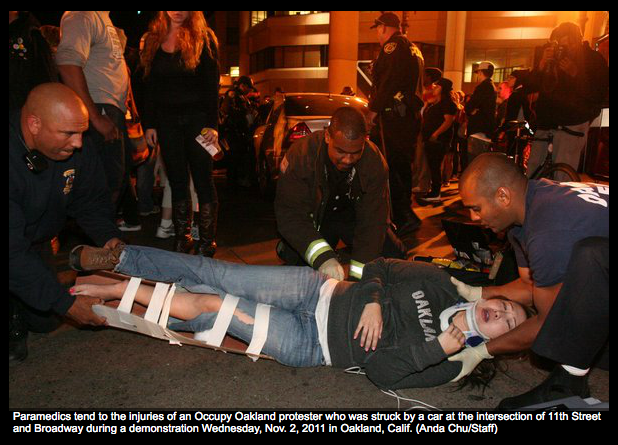


Monday, October 31, 2011
Mormon Halloween

Apparently quite serious:
Some people do not believe that there are any devils. There are thousands of evil spirits that are just as ugly as evil can make them. The wicked die, and their spirits remain not far from where their tabernacles are. When I was in England, twenty-eight years ago next June, I saw more devils than there are persons here to-day; they came upon me with an intention to destroy me; they are the spirits of wicked men who, while in the flesh, were opposed to God and his purposes. I saw them with what we call the spiritual eyes
-Heber C Kimball 1865
This one also serious and referring to rappers in the 19th century:
Let the Rappers go ahead, then, for it is not possible for them to deceive the elect of God; and let the witch of Endor, and all other witches and wizards, with the prince and power of the air at their head, do their best, if we keep the commandments of God we shall continually soar far above their power and influence.
-Jebediah M Grant 1854
A home-teaching joke:
I remember a question someone once asked at a stake conference. A man said, " Brother Howard, do you know why we can never get more than 83 percent home teaching in the Church? " I said, " No, why? " He said, " Because no one wants to go on Halloween and New Year's Eve. "
-F Burton Howard 1996
Seemingly harsh and real story:
In the bishops' meeting last evening in this hall, Bishop M. O. Ashton told two stories that deeply impressed me. Each story was about a bishop and some boys. In the first one, a group of boys engaged in some Halloween pranks of a rather serious, provocative nature. The bishop secured the names of the boys and charged them to come to the sacrament meeting and publicly ask forgiveness for engaging in the pranks committed, on pain of excommunication for failure to do so. In consequence there are in that community today a number of families that grew up outside of the Church.
-Joseph F Merill 1945
Scary that this was said straight faced in general conference:
To look upon a man who is deformed or maimed for life, -- a dislocated jaw, a broken nose or an eye knocked out -- is naturally revolting. How unsightly and ugly!
-Rulon S Wells 1929*
Scary cautionary tales:
We ourselves are the creators, in a large measure, of our troubles. Once, so the old story goes, a medical student determined to build a monster out of the cemetery and dissecting rooms. He did so, and the thing assumed life. This horrible monster killed the student's bride and strangled his best friend. Is there a lesson in this for us?
-Charles A Callis 1935
Robert Louis Stevenson captured this constant struggle between good and evil in the classic novel about Dr. Jekyll and Mr. Hyde. The story tells us that in the beginning " Dr. Jekyll is a highly respected London physician, a good and kindly man, who in his youth had showed inclinations toward evil which, however, he succeeded in suppressing. Interested in drugs, the doctor now chances upon one which enables him to change his external form to that of a repulsive dwarf, the very embodiment of evil, whom he calls Mr. Hyde. A similar dose permits him to return to the form and personality of the benevolent doctor. Many times the doctor becomes Mr. Hyde, thereby giving this side of his nature more and more power. Jekyll finds it increasingly difficult to regain his virtuous entity and also finds himself occasionally becoming Hyde without the use of the drug... "
-James E Faust 2000
And finally, a calming tale on Halloween:
I want to tell you a story. I call it " Night and Shadows. " " Once upon a time, a little girl wandered through a dense forest on her way home. It was very dark. She was frightened and began to cry. The tears rolled down her face, as she timidly crept along. Suddenly an elf appeared before her.' Are you frightened' asked the elf.' Yes, I'm scared,' answered the little girl, glad to show her fear,' Ain't you?' "' Not a bit,' answered the elf. "' Well then you don't see the ghosts and goblins running around the trees, and the funny looking eyes up there in the branches, and the bats and ugly things flying through the air, and the scary noises, can't you hear them?' " And the elf said:' I don't blame you for being scared, I'd be scared too if I saw all those ugly things. You see that when little girls have tears in their eyes, they can't see things as they really are.' "' Just let the tears dry in your eyes, and then we shall take a good look at these ghosts and goblins, and ugly things. See those terrible eyes in the branches of the trees? Why they are just the stars trying to light up your pathway so that you can find your way home; and the big moon is trying to help them. And those big things aren't ghosts, they are just the shadows of the trees. And what you thought were ugly bats and ugly things are just the leaves falling on your pathway, making the path soft for your tired feet. And the noises. Why, that's the wind blowing through the branches, and the trees are trying to sing a song to make you happy as you go along'.
-Levi Edgar Young 1932
Happy Halloween!
* Here's the quote in context (not that it helps):
But says one: I have no faith in God and no hope in a future life. How unnatural! How such a one must have resisted every natural impulse of the heart to have fallen into such an abnormal state of mind! No faith, no hope. Spiritual deformities. To look upon a man who is deformed or maimed for life, -- a dislocated jaw, a broken nose or an eye knocked out -- is naturally revolting. How unsightly and ugly! But not half so hideous or so repulsive is he who is thus physically deformed as he who is spiritually deformed, wanting in these Christian qualities so inherent and natural to all mankind. No faith: he does not ask and hence does not receive; he does not seek and hence he does not find; he does not knock an therefore the door is not opened unto him. No hope. How unnatural! -Rulon S Wells 1929
Tuesday, October 18, 2011
Mormons #OccupyWallStreet. #occupy

"THE EXPERIENCE OF MANKIND has shown that the
people of communities and nations among whom wealth
is the most equally distributed, enjoy the largest degree
of liberty, are the least exposed to tyranny and oppression
and suffer the least from luxurious habits which beget vice... One of the great evils with which our own nation is menaced at the present time is the wonderful growth of wealth in the hands of a comparatively few individuals. The very liberties for which our fathers contended so steadfastly and courageously, and which they bequeathed to us as a priceless legacy, are endangered by the monstrous power which this accumulation of wealth gives to a few individuals and a few powerful corporations. By its seductive influence results are accomplished which, were it equally distributed, would be impossible under our form of government. It threatens to give shape to the legislation, both state and national, of the entire country. If this evil should not be checked, and measures not taken to prevent the continued enormous growth of riches among the class already rich, and the painful increase of destitution and want among the poor, the nation is likely to be overtaken by disaster; for, according to history, such a tendency among nations once powerful was the sure precursor of ruin." -Brigham Young, the First Presidency of the Church, and the Quorum of the 12 Apostles, July 1875 (click here for a fun compilation of quotes from this circular)
Although that quote from an apostolic circular in 1875 was talking about the vital importance of the mormons' participation in ZCMI, the statement rings just as true today. In the past few decades we've seen much of this statement occur before our very eyes. I chose this to start a series of posts on #OccupyWallStreet, with particular focus on what Mormonism has to say about the concepts and ideas behind the movement.
Maybe it's just me and my ADD, but it seems to me that the ideal format of a blogpost is short and sweet. I plan on addressing several things later on in this series:
- What is and isn't #OccupyWallStreet all about?
- What virtues does the left see in the movement, and what virtues does the right see? (Can both sides come together?)
- What aspects of Mormonism back the views of the Left and the Right in this movement?
- Could the venom between the Left and Right blind us to greater problems?
PS: As fate would have it, as I was looking for a nice picture to use for this post, I found this excellent post at the Mormon Worker, which addresses several of these items and had some awesome graphics, one of which I'm using above.
Subscribe to:
Posts (Atom)